Published shortly after the stock market closes five days a week - excluding public holidays - Biotech Daily is the only comprehensive daily source of information on the listed biotechnology sector.
The Biotech Daily Top 40 Index (BDI-40) is selected on the basis of interesting technologies, benefit to human health and investment potential. Market capitalization is important, but is not a sole arbiter.
2026 base-rate subscriptions are $A2,350 a year (including GST in Australia).
Subscribers include biotech directors and CEOs, major pharmaceutical companies, universities, research institutes, investment houses, market analysts, retail investors, doctors, medical specialists and hospital management.
September was a strange month for the Biotech Daily Top 40 Index (BDI-40).
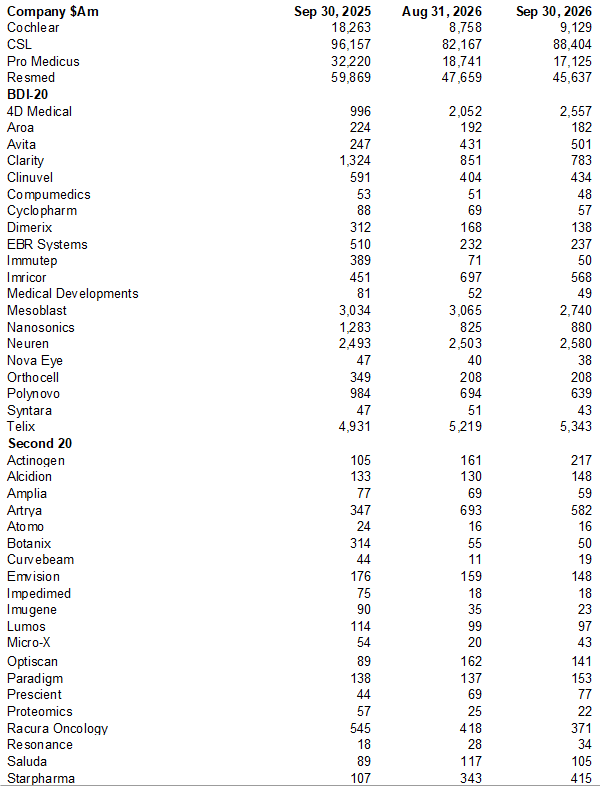
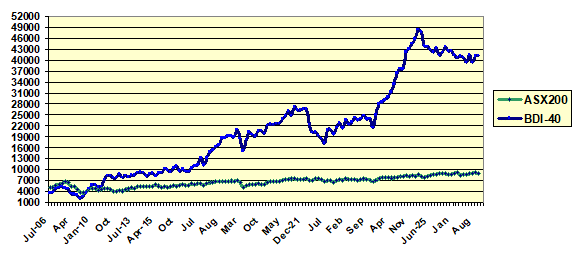
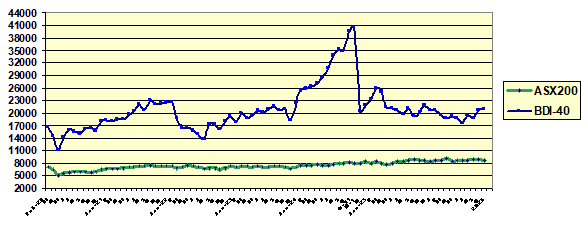
The BDI-40 was up 0.8 percent to a collective market capitalization of $20,813 million, but 22 companies were down for the month, of which 13 fell more than 10 percent; 15 companies were up, with 10 up by more than 10 percent; and three were unchanged.
The $505 million or 24.6 percent improvement in 4D Medical’s fortunes – to $2,557 million - explains the quandary.
The benchmark ASX200 fell 3.2 percent to 8,789 points in September and the Nasdaq Biotechnology Index (NBI) slipped 0.1 percent, but was up 45.8 percent for the year.
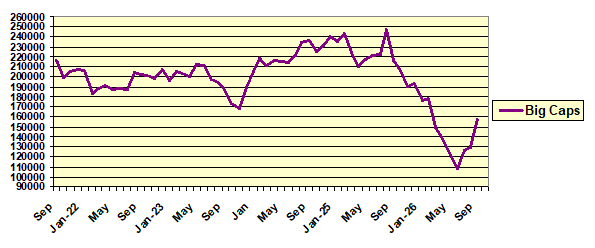
The four Big Caps of Cochlear, CSL, Pro Medicus and Resmed, which are not included in the BDI-40, improved a collective 1.9 percent to $160,295 million, but 22.4 percent below the $206,509 million, a year ago.
CSL again led the Big Caps, recovering a further $6,237 million or 7.6 percent to $88,404 million, Cochlear climbed 4.2 percent to $9,129 million, Pro Medicus was down 8.6 percent to $17,125 million and Resmed fell 4.2 percent to $45,637 million.
Micro-X was the September percentage best, from a low base, up $23 million or 115.0 percent to $43 million, followed by Curvebeam up 72.7 percent to $19 million, Actinogen (34.8%), 4D Medical (24.6%), Resonance (21.4%), Starpharma (21.0%), Avita (16.2%), Alcidion (13.8%), Paradigm (pre-suspension; 11.7%) and Prescient (11.6%).
Imugene led the falls, down $12 million or 34.3 percent to $23 million, followed by Immutep (29.6%), Imricor (18.5%), Dimerix (17.9%), Cyclopharm (17.4%), Artrya (16.0%), Syntara (15.7%), Amplia (14.5%), Optiscan (13.0%), Proteomics (12.0%), Racura (11.2%), Mesoblast (10.6%) and Saluda (10.3%).
Outside the BDI-40, Echo IQ fell 57.5 percent from the billion-dollar club to $445 million
Vitrafy was again at its highest end-of-month valuation at $305 million, Cogstate climbed a further 10.1 percent to $586 million, and PYC rose 15.5 percent to $2,636 million, while Tissue Repair remained at $5 million, down 72.2 percent for the year.
The 11 companies in Cannabis & Psychedelics Corner fell 3.78 percent for the month – up 45.8 percent for the 12 months to September 30, 2026 - led by Vitura down $4 million or 23.5 percent to $13 million, followed down by Argent (25.0%) and Avecho (18.0%); with Nexalis (Inhalerx) up 100 percent to $4 million and Epsilon up 25 percent to $10 million.
On the Nasdaq, Kazia lost 28.2 percent to $158 million, Eyepoint (Psivida) fell 25.6 percent to $395 million, and Queensland’s Protagonist slipped 1.6 percent to $13,124 million. Israel’s Redhill Biopharma with Australian assets tumbled 50 percent to $4 million, while Neuphoria (Bionomics) was unchanged at $28 million.
Incannex was the only Australia biotechnology company on the Nasdaq to improve, up 5.4 percent to $59 million.
Biotech Daily editor, David Langsam, owns shares in 4D Medical, Acrux, Actinogen, Alcidion, Amplia, Clarity, Cochlear, EBR, Nanosonics, Neuren, Patrys, Percheron, Polynovo and Telix, as well as unlisted and non-biotechnology stocks.
Through Australian Ethical Superannuation he has an indirect interest in a range of biotechnology companies.
These holdings are liable to change:
https://www.australianethical.com.au/personal/ethical-investing/companies-we-invest-in/